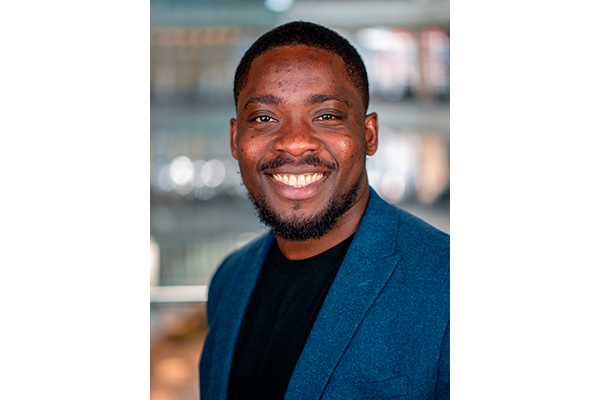
Harry Akligoh, PhD’28, bioengineering, participating in Northeastern’s Global Dual PhD program, uses an innovation mindset to create new techniques for studying the connection between cancer treatments and cardiovascular problems through the Northeastern College of Engineering and the Université Paris-Saclay.
Harry Akligoh’s path to becoming a bioengineering PhD student in Northeastern’s unique Global Dual PhD program began in a college classroom in Ghana. There, he transformed household materials into science experiments for local schoolchildren, “We didn’t have basic amenities in terms of laboratory infrastructure, so I used household materials to teach young kids to perform simple experiments, helping them understand photosynthesis and other abstract concepts.” This early innovation mindset substantially shaped Akligoh’s career trajectory. After earning his bachelor’s degree in medical laboratory science, a chance meeting at a conference with a researcher from the University of Cambridge opened doors he hadn’t imagined could be possible. She recruited him to establish a laboratory in Ghana focused on producing biology enzymes using off–patent biotechnologies, democratizing access to research tools by utilizing public domain knowledge. At just 22, fresh out of his undergraduate, Akligoh spent three years building a lab from scratch, learning to raise funds, manage research, and navigate the complexities of international scientific collaboration.
Building Bridges Between Continents
Today, Akligoh is tackling one of medicine’s most complex challenges through his dual PhD program between Northeastern College of Engineering and the Université Paris-Saclay. His research sits at the critical intersection of cardiology and oncology, addressing a troubling reality – many cancer treatments cause cardiovascular complications in patients, “For a very long time, people were trying to understand this problem in isolation. Now we’re building model systems that allow us to understand this from a holistic point of view.”
The dual program, which Akligoh learned about from his advisor Professor Tania Konry, combines Northeastern’s expertise in droplet microfluidics, a technology that manipulates tiny droplets of fluid within a device to create many “mini-experiments” in a single run, with Paris-Saclay’s strength in cardiovascular pathophysiology research. This complementary approach enables him to develop innovative platforms that can model the interaction between cancer treatment and heart health, work that could ultimately lead to safer, and better, therapeutic strategies for cancer patients.
Culture Beyond the Lab
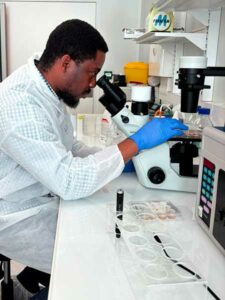
Akligoh working in the lab Photo credits: Northeastern University, Department of Bioengineering, Graduate Student Council
During his two-month research stint in Paris, Akligoh received advice that crystallized his approach to global scientific collaboration. His French PI told him, “Don’t just focus on the lab culture, which is like the cell culture, but also focus on the culture of the city in which you find yourself.” Taking this to heart, Akligoh attended the Fête de la Musique festival, an international celebration of live music, where both amateur and professional musicians alike perform in public spaces like streets, parks, and plazas. He also explored Paris with fellow researchers and immersed himself in French scientific and social culture.
He said of the experience, “It just felt like home in another country.” This cultural openness reflects Akligoh’s broader philosophy about scientific innovation. From teaching science with only household materials in Ghana to developing cutting-edge microfluidic platforms in cosmopolitan cities like Boston and Paris, he understands that breakthrough solutions often emerge when different perspectives, resources, and approaches are combined.
Vision for Global Impact
Having experienced scientific research in Africa, North America, and Europe, Akligoh brings unique insights to PhD students considering Northeastern for their graduate studies, “For anyone looking forward to doing biotech and being really innovative, this city is the epicenter.” His own journey demonstrates that scientific innovation isn’t confined to well-equipped laboratories in wealthy nations, it can grow anywhere there’s curiosity, determination, and a willingness to see problems from new angles.
Through the Global Dual PhD program, Akligoh is actively combining his biological expertise with his engineering skills to address global health challenges. His work on cardio-oncology could improve treatment outcomes for cancer patients worldwide, while his commitment to accessible science education and low-cost tool development continues to inspire the next generation of innovators, whether they’re in Boston, Paris, or Accra. For Akligoh, the dual PhD isn’t just about earning degrees from two prestigious institutions, it’s about creating bridges between diverse scientific communities, approaches, and cultures to tackle problems that transcend borders.
More about Harry:
Harry Akligoh grew up in Keta, a small fishing town in southern Ghana, where his late father, a retired army officer, and mother, a petty trader, worked tirelessly to support Harry and his twin sister. Despite financial hardships, such as not owning a computer until college, his parents never stopped believing in the power of education. Their sacrifices became Harry’s motivation to work harder and dream bigger. From an early age, he was captivated by biology and how life works, which naturally evolved into a passion for science and innovation. Today, that same curiosity fuels his mission to develop biotechnologies that address global health challenges and ensure that scientific progress benefits everyone, everywhere. In his free time, Harry works on his startup, Duplex Bioscience, which works to improve antimicrobial resistance (AMR) data collection, build software tools for better AMR diagnostics, and connect AMR data silos in Ghana.
LinkedIn: Harry Akligoh, X: @harryakligoh, website(s): https://konrylab.sites.northeastern.edu/ , https://duplexbio.science/
If you are interested in a Global/Dual PhD, or are curious about learning more, please contact Wendy Eaton, director of LEADERs partnership relations.