Uncovering Unexpected Protein Creation Processes in the Human Body
BioE Professor Nikolai Slavov and his team discovered that unexpected amino acid substitutions create abundant, stable proteins in the human body that deviate from standard genetic instructions.
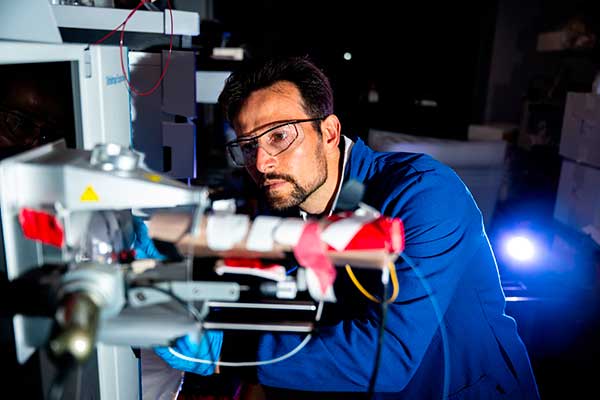
This article originally appeared on Northeastern Global News. It was published by Cesareo Contreras. Main photo: Nikolai Slavov, Northeastern professor of bioengineering, studies the development of proteins in the body. Photo by Alyssa Stone/Northeastern University
A new study suggests that our bodies produce more proteins than we thought
Northeastern research reveals that humans have a “highly abundant” number of stable proteins that are not all predicted by genetic code.
In 1968, the American biochemist and geneticist Marshall Nirenberg and his colleagues won the Nobel Prize in Physiology or Medicine for their work deciphering how an organism’s proteins are directly linked to its genetic code.
That discovery is considered to be a “fundamental pillar of molecular biology,” explained Nikolai Slavov, a distinguished professor of bioengineering. “It’s in every textbook from high school to college.”
For years, researchers have worked to build on Nirenberg’s work and to develop a deeper understanding of how proteins – which are responsible for muscle, skin and tissue maintenance — are formed.
Research from Slavov published in the scientific journal Nature adds a new chapter to the story. It reveals that humans contain a “highly abundant” number of stable proteins that are not all predicted by their genetic code, according to Slavov.
It wasn’t that Nirenberg’s finding was wrong, Slavov said. “We discovered that it is incomplete,” he explained.
Slavov’s and his colleagues’ findings could one day aid in the development of cancer treatments and in neurodegenerative conditions, like Alzheimer’s and Parkinson’s disease, which are characterized by protein dysfunction, he said.
The researchers spent years analyzing RNA, bedrock molecules in the production of proteins and DNA, bedrock molecules that carry genetic information, and other data from more than a thousand human samples. Much of the data was collected from the National Cancer Institute’s Health’s Clinical Proteomic Tumor Analysis Consortium, a national project designed to advance our understanding of cancer on a molecular level, and other public datasets.
The dataset included both healthy human tissues and samples from individuals with several different types of cancer, including renal, uterine, breast, prostate, and various forms of lung cancer.
Read full story at Northeastern Global News