Aligning Two Paths: Evan Yee’s Journey with Medicine and Engineering
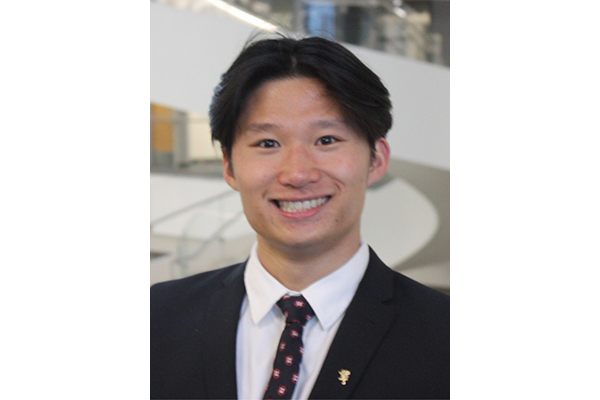
Evan Yee portrait. Photo sourced from LinkedIn.
Evan Yee, E’26, combined bioengineering and biochemistry, is graduating this spring with plans to pursue medical school and, eventually, research—hoping to become a pioneering force in the advancement of human health.
Evan Yee completed his bachelor’s degree in combined bioengineering and biochemistry at Northeastern this spring. His interest in biology and medicine traces back to his mother, a physician, and to watching older family members age. Witnessing the physical effects of aging up close was unsettling—but learning the science behind those processes made them less frightening, and more fascinating. That curiosity deepened through AP Biology and Anatomy in high school, where each new layer of the human body only increased his desire to understand more.
Yee was drawn to Northeastern primarily by the Co-op Program, which offered something he valued: the chance to test fields of interest through full-time work experience before fully committing to them. The university’s study abroad opportunities and its standing as an R1 research institution also factored into his decision. He entered as a biology major but quickly found the coursework unsatisfying. “I wanted to do more with what I was learning,” he says—to apply his knowledge in tangible ways rather than study it in the abstract. Discovering bioengineering gave him exactly that, and he found himself equally drawn to both engineering and medicine.
Current Research
Yee is an undergraduate researcher at the Optical Microscopy and Neuro-Imaging Lab (OMNI) at Northeastern. His work centers on a specialized microscope for mesoscopic imaging—a scale of observation that falls between the microscopic and what is visible to the naked eye—used to study the brains of awake, living rodents. Much of his work to date has focused on making the microscope fully functional. Together with his colleagues, he uses the instrument alongside genetically modified mice with small surgically implanted windows in their skulls to study blood flow and brain activity in real time. Understanding these dynamics in living brains can illuminate what goes wrong in diseased states and point toward potential treatments. Yee received the PEAK Summit Spring 2025 award for his work replacing a segment of the microscope responsible for delivering light to the brain’s surface with an improved lens system.
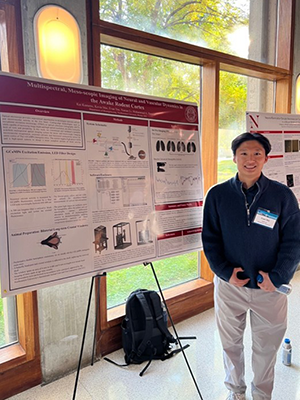
Yee presenting his research. Courtesy photo.
He is grateful for the lab space, equipment, and funding Northeastern has provided to make the work possible. Beyond the technical contributions, the experience has shifted how he approaches scientific thinking altogether—teaching him where real-world data actually comes from and what its limitations are. He now reads scientific claims with a more discerning eye, examining carefully how researchers support their conclusions rather than accepting them at face value.
Co-ops
Yee completed two co-ops during his time at Northeastern. At Fresenius Medical Care, he worked as a systems engineer focused on kidney dialysis machines—sourcing replacement parts that manufacturers no longer produced and ensuring the devices continued to meet strict medical regulatory standards. One project he found particularly engaging involved investigating a malfunctioning lock site, a needleless access point used to draw blood from patients. The component was leaking, and it was Yee’s job to determine why. Given full independence to investigate, he treated the lab as his own space to experiment and reason through the problem systematically. The team eventually concluded that the part itself was failing. His key takeaway: never assume a component works as intended until you have data to prove it.
Concurrently, Yee was working part-time as an EMT for Costal Medical Transportation Systems, transporting patients for both emergency and non-emergency situations. He frequently transported patients to dialysis appointments and spoke with them about the care they were receiving—giving him a patient-facing perspective that directly informed his work at Fresenius. Being able to work behind the scenes on the machines while also hearing from the people who depended on them was, he says, invaluable.
Mentorship and Extracurriculars
Since his second year, Yee has been mentored by Assistant Professor of Bioengineering Mohammad Abbas Yaseen, who also serves as his research advisor. Professor Yaseen has been a consistent source of guidance across both research and career questions, and Yee is struck by how reliably he makes time for students despite his many responsibilities. He also singles out Professor Yaseen’s clarity as a teacher and his evident passion for the subject. The relationship has been, in Yee’s view, a defining part of his Northeastern experience.
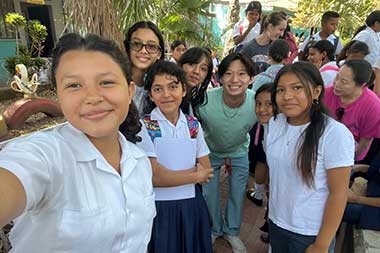
Yee on his Medical Brigade trip. Courtesy photo.
Outside his studies, Yee has been deeply involved in the Northeastern Global Medical Brigades chapter, which brings together students and healthcare professionals united by a shared interest in global health. Each spring, the chapter travels internationally to set up makeshift clinics for communities facing barriers to medical or dental care—staffing stations for triage, consultations, dentistry, optometry, pharmacy, and dental hygiene education for children. Students rotate through the stations, taking vitals and learning by shadowing healthcare providers. Yee has participated in three trips, most recently as club president during a visit to Panama. Moving from regular member to president required a significant shift in how he operated—learning to delegate rather than simply do, and to weigh factors like deadlines, task complexity, and team members’ workloads to keep 54 students and two physicians on track for an international trip. The experience also taught him to resist quick judgments. “Don’t jump to conclusions until you understand the complete situation,” he advises—a lesson that proved especially useful when problems looked different up close than they had from a distance.
Yee also volunteers at Massachusetts General Hospital, guiding and transporting patients by wheelchair throughout the building. The interactions are brief, but speaking with patients before a significant surgery or appointment—offering reassurance, a listening ear—has been among the most rewarding parts of his undergraduate experience. It also gives him a face-to-face reminder of how his research could one day make a difference in someone’s life.
Reflection and Looking Forward
As he wraps up his time at Northeastern, Yee’s advice to younger students is to “involve yourself in things for the right reasons.” He acknowledges the pressure—one he has felt himself—to accumulate experiences and credentials, sometimes at the cost of genuine engagement. His recommendation is to be deeply involved in a handful of things that actually interest you, rather than superficially committed to many things that simply look good on a résumé.
This summer, Yee moves on to medical school as his immediate next step, with plans to layer in more engineering as his career develops. He hopes eventually to become a true expert in a specialized field—and more than anything, to one day discover something, in medicine or in the study of the human body, that benefits others and advances human health.