Bridging Biology and Technology: Computational Bioengineering Creating Results
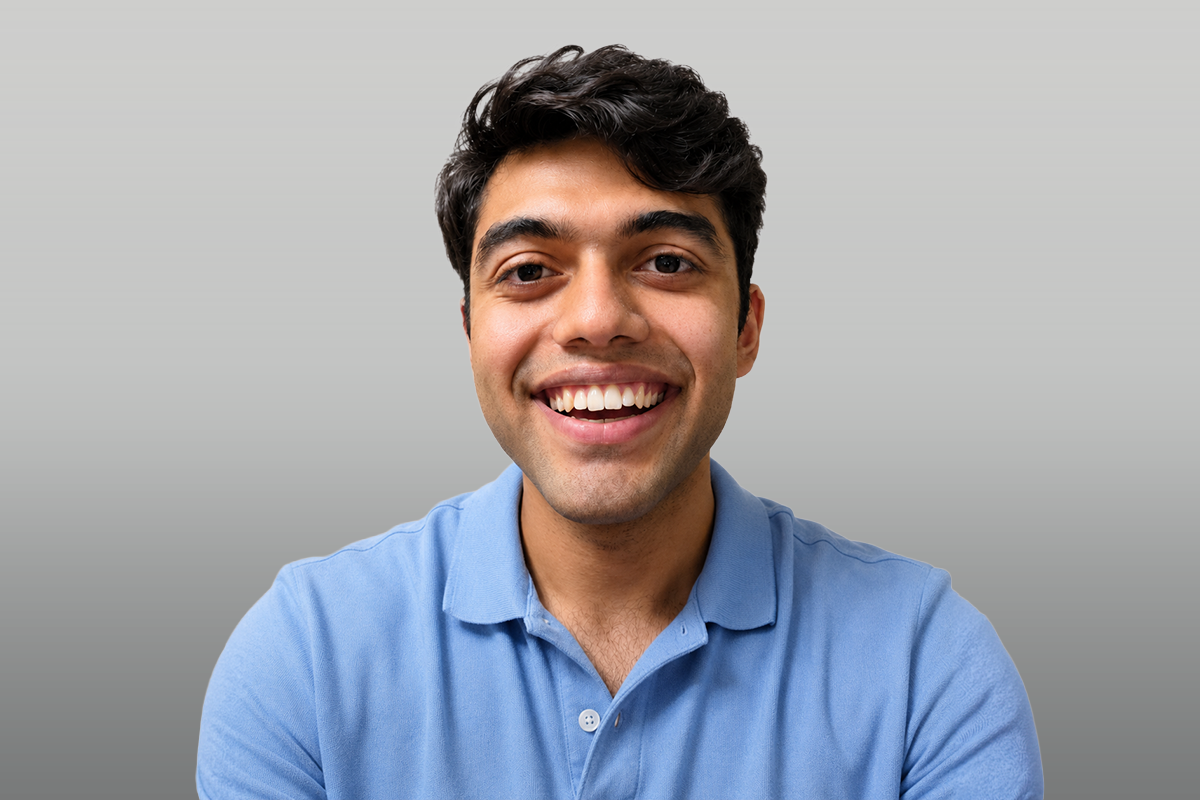
Amit Shenoy, BS’25, bioengineering, graduated from Northeastern after completing two co-ops and a research experience at COMBINE Lab. Throughout his studies Shenoy has stayed committed to sustainability, community, and results—ideas he takes with him into his professional career. Courtesy photo.
Amit Shenoy completed his bachelor’s degree in bioengineering at Northeastern last December. As a child Shenoy wanted to be a doctor and was drawn to his biology classes in middle and high school. His interest piqued when he first learned about the brain, which he describes as “the most complicated technology in the universe that we know of.” As he started to learn the complexities of the brain, his interest in biology and technology merged into computational biology. This passion, along with being fascinated by watching his father work in the IT field, led Shenoy to pursue bioengineering with a concentration in computational bioengineering.
In high school, Shenoy was looking to start a biotechnology club after the pandemic and first discovered Northeastern through a “guide” the school had given to high school students looking to pursue biotechnology. As he started to look into different universities, an important factor for Shenoy was staying close to home and going somewhere with a good research reputation. Northeastern met all of his requirements. Looking deeper, he was intrigued by the Co-op Program and the opportunity to get out of the classroom to apply his skills.
Co-op and research
Shenoy completed two co-ops during his bachelor’s degree, with the first located at Arbor Biotechnologies, which develops gene therapies—treatments that work by delivering genetic material into cells. To test the performance of their treatments, they expose them to various viruses. Shenoy worked for the team that grew these modified viruses that act as delivery vehicles for the therapy. His role was to optimize the production of viruses by using different chemical processes to get more usable viruses out of each batch to use in their therapeutic testing. At Arbor, Shenoy learned the importance of experimental design, ensuring that they can repeat an experiment enough times to produce reliable results.
His most memorable experience was at UCB, a biopharmaceutical company. There, Shenoy’s main role was to work on a tool that can narrow down a large pool of potential drug candidates and identify the most promising ones. For this, he created a prediction model, trained on a vast array of data entries from scientific literature, so he could put a protein and a drug candidate together and estimate how they would interact with each other. Having even the most basic predictions would narrow down the list, where the best group of candidates would be sent off to another team for further testing. As his first computational experience, he learned how to use software like machine learning tools in the pharmaceutical field as well as engineering skills like rapid prototyping. He also highlights the value of learning to work across disciplines—as computational scientists often serve as the link between laboratory researchers and IT teams. Shenoy also wishes to highlight UCB’s professional development resources for co-ops, which helped him sharpen his resume and interview skills as he moved on to future opportunities.
Shenoy also completed research at the COMBINE Lab at Northeastern, run by Assistant Professor Mona Minkara. His main project was studying a protein called lectins, which is the first line of defense against any sickness that enters the lungs. He used computer simulations to study how these proteins would interact with viruses on a molecular level. By understanding how these proteins fight off infections, scientists could potentially manipulate them—improving existing lectins to boost immunity to respiratory disease or engineering better ones for use in drugs and vaccines. As his first academic lab experience, he was given a lot of insight into what research already exists in this field, learning how to compile the main ideas in different papers and follow citation trails. Shenoy is also grateful for the opportunity to work at the lab alongside Professor Minkara, someone who he admires as a “trailblazer” and fantastic professor.
Impact on campus
As for extracurriculars, Shenoy focused on making an impact on sustainability. He joined the Northeastern Student Government Association and eventually became the assistant vice president for the sustainability committee. While still rebuilding after the pandemic, he was grateful to get leadership experience early on while connecting with a community of passionate peers. After that he joined the Sustainability Hub, where he served as co-chair for two years, focusing on outreach for collaborations and connecting Northeastern leaders under the cause of sustainability. While students often feel as though they are not doing enough in this field, Shenoy recommends anyone interested in sustainability to surround themselves in a community or club focused on sustainable goals. As a leader, the most important thing he learned from these organizations was to celebrate the small wins and the necessity of strategy by working through one challenge at a time. A key part in this work is to build relationships in his department to gain necessary context before taking action.
One course that Shenoy enjoyed is the Cornerstone of Engineering course taught by Teaching Professor Joshua Hertz. While a required course for all engineering students, Professor Hertz put his own spin on it, making the class centered around games. Shenoy appreciated the change of pace and how much thought was put into each aspect of his teaching, such as writing on a whiteboard instead of using a PowerPoint slideshow. This course also included many project-based activities that allowed engineers to practice hands-on learning rather than purely theoretical knowledge. Shenoy describes Hertz as “his favorite professor by far,” emphasizing his accessibility with questions and office hours as well as his supportive nature with providing students with any resources they need.
Advice and future plans
As a recent graduate, one piece of advice Shenoy has for current engineering students is to “know what to pay attention to” in regard to professional development. He explains that the things people care about in industry and academia are wildly different, and often students come into co-op unprepared for the change in environment. Shenoy recommends that students try to shadow work in any industry even before their first co-op to better understand the mentality of industry, stating, “It is often very easy to keep up with the nice problems that the classroom sets up, but in industry you do not know half the puzzle you’re solving; you don’t even know what puzzle you’re solving.” He believes that gaining any sort of work experience before the first co-op will teach students what they “should” care about when the time comes to actually enter the field, such as not basing their work on letter grades.
As of now, Shenoy plans to gain more research experience in both industry and academia before committing to his PhD with a stronger research direction. Once he feels he is ready he is planning to come back to academia to pursue a PhD, something that will open more doors for him in his long-term career. He likes the idea of having a direct impact on a patient and will continue to pursue roles where he can achieve that. With the way artificial intelligence and software is expanding, he hopes that one day he can be a part of making drug discovery fully automated, giving patients results much faster than today’s research process allows. With his commitment to results, Shenoy will be a catalyst for change in the biotech and pharmaceutical field.