Curiosity and Learning Lead to Positive Impact
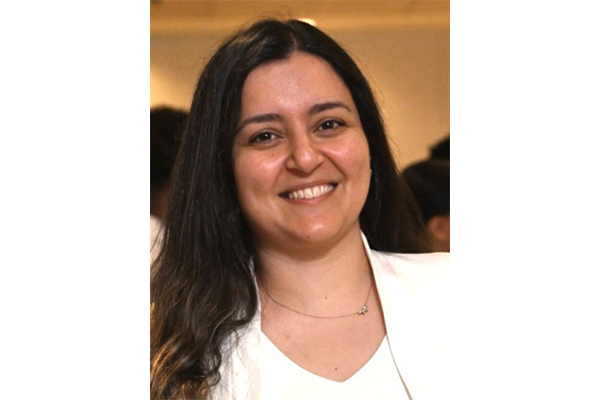
Fereshteh Sadeghian portrait. Photo sourced from LinkedIn.
Fereshteh Sadeghian, PhD’26, bioengineering, is currently a graduate research assistant at the Cram Lab at Northeastern. With her passion for learning and a desire to improve healthcare research, Sadeghian will continue to apply her knowledge and experience to find innovations in the medical field.
Fereshteh Sadeghian is currently completing her PhD in bioengineering at Northeastern University. She has always had an interest in science and enjoyed building things to explore how they functioned when she was younger. With both a bachelor’s and a master’s degree in chemistry, her extensive research has involved extracting chemical compounds from natural products for the purpose of drug discovery.
At Mazdan University of Medical Services, Sadeghian recalls that she “fell in love with biology.” Additionally, she has a passion to pioneer research and “push the boundaries of research”, so she concluded that a PhD would be the right path for her. She was drawn to Northeastern by its excellent research reputation, as well as the convenience of its Boston location—which Sadeghian deems the “hub of bioengineering.” As she was researching the faculty, she became very interested in the work being done at Cram Lab.
Research
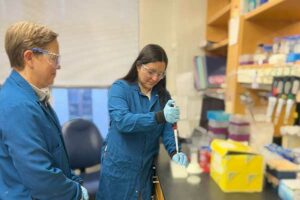
Sadeghian (right) and her P.I. Erin Cram (left) working in the Cram Lab. Courtesy Photo.
Sadeghian’s research in the Cram Lab uses biological tubes as model systems to study how smooth muscle cells expand and contract. Since genes are the primary driver of muscle cell behavior, her work involves overexpressing and knocking down specific genes to understand their effects on cellular function. Ultimately, this research could help develop treatments for diseases caused by the dysregulation of these genes. Recently, her team discovered a particular protein that controls a key aspect of muscle contraction. Sadeghian’s work explores how different genes and proteins contribute to smooth muscle contraction and how these components interact within a regulatory network.
Sadeghian credits Northeastern’s well-equipped facilities and vast resources for enabling her to conduct such worthwhile research. Additionally, since other labs and departments occasionally hold seminars to present each other’s research, she is able to not only gain useful feedback in her own research but also learn and collaborate with the projects of other labs.
Lessons and appreciation
As she nears the end of her program, Sadeghian recalls that the first lesson she learned was how to communicate with others in a second language. She notes that her P.I, Associate Dean for Research and Professor Erin Cram, supported her through this challenge. Specifically, Professor Cram pushed Sadeghian to master public speaking, something that made her nervous at first. However, with the consistent practice of presenting in front of other labs, at seminars, and academic conferences, Sadeghian now has the confidence and experience to communicate her work in any setting.
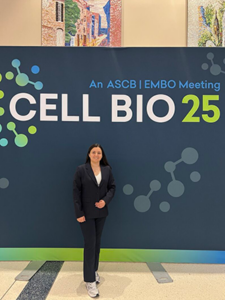
Sadeghian at the 2025 Cell Bio conference. Courtesy Photo.
Sadeghian really appreciates how Northeastern cultivates an environment of collaboration. She notes that Cram lab not only collaborates with other labs at Northeastern, but also among other institutions across the country. Sadeghian also values the opportunity to mentor undergraduate students in the lab, teaching them the fundamentals of lab science and research.
Sadeghian is grateful for her weekly lab meetings with Associate Professor Javier Apfeld. She credits his useful feedback on her research with helping her grow as an academic. With a background in genetics, Professor Apfeld’s perspective afforded Sadeghian new ways to consider and expand her own knowledge.
Sadeghian also appreciates the program LEADERs, which is a professional development program created by the PhD Network focused on doctoral students. This program allowed Sadeghian to “rethink integrity, accountability, and courage, and also develop skills like decision-making, problem-solving, team management, and more”, broadening and deepening her professional prowess.
Looking ahead
Upon completing her PhD program, Sadeghian hopes to work in a research role for a biotech or pharmaceutical company. She aims to combine all she has learned in chemistry, biology, and engineering in her career pursuits. Sadeghian wishes to study the mechanics of disease to be able to inform and educate in the event of future health concerns like the Covid-19 pandemic. Specifically, the vaccine and immunology field is compelling to Sadeghian, and with her passion for learning and service, Sadeghian will continue to use her research and lab experience to improve understanding and treatment in the medical field.