Minkara Wins 2026 Sloan Fellowship for Pulmonary Protein Research
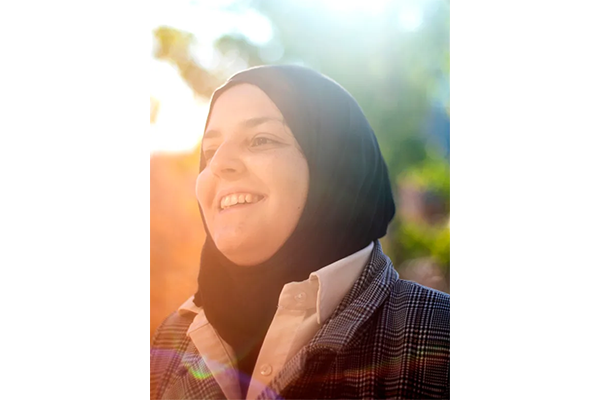
Mona Minkara and Soheil Behnezhad have both received Sloan Foundation fellowships, which support early-career scientists. Photo by Matthew Modoono
Assistant Professor Mona Minkara, bioengineering, was given the 2026 Alfred P. Sloan Fellowship for her research at Northeastern. She is studying a protein called collectins within the pulmonary surfactant, hoping to model its functions to enhance innate immunity from the lungs.
This article originally appeared on Northeastern Global News. It was published by Noah Lloyd.
Two Northeastern professors among newest Sloan Foundation fellows
Northeastern University professors Soheil Behnezhad and Mona Minkara have been awarded fellowships from the Alfred P. Sloan Foundation.
The fellowships recognize early-career researchers employed in a higher education institution “who have the potential to revolutionize their fields of study,” according to the foundation.
Each year, the Sloan Foundation announces a new cohort of fellows who receive two years of funding. In an announcement yesterday morning, two Northeastern professors were named among the latest recipients.
How we breathe
Minkara, an assistant professor of bioengineering, says that her research focuses on computationally modeling the molecules that interface between the lungs and the air we inhale, which allow us to breathe.
She has also received a 2026 Alfred P. Sloan Foundation Fellowship.
That interface substance is called the pulmonary surfactant, and is made out of proteins and lipids, she says. Her latest research attempts to model a type of protein within the surfactant called collectins, which Minkara says are “our first line of immune defense.”
In the pulmonary surfactant, collectins identify pathogens attempting to enter the body through the lungs. “I try to understand how they do that,” Minkara says.
“We don’t really know how these collectins work,” she continues. Therefore, “we don’t really know how to enhance innate immunity.”
Both Behnezhad and Minkara have also received NSF CAREER awards — Behnezhad in 2025 and Minkara in 2024 — which also support scientists early in their careers.
The Sloan Foundation describes its fellows as early-career scientists “whose creativity, innovation, and research accomplishments make them stand out as the next generation of leaders.”
Minkara says that the fellowship will help fund her sabbatical year, during which she is trying out something exciting: moving from pure computation to working in a laboratory.
She says that she and her collaborators will look at a specific collectin, how it binds to bacteria and whether that process could assist the immune system. They’ll perform this experiment in mice.
“I’m a computationalist, this is a big step,” she says with a laugh.
She thinks that this might be one reason why the Sloan Foundation selected her work, “because it’s translational,” she says, and because she herself is at a pivot point moving from theory and computation into the experimental lab.
Read Full Article at Northeastern Global News