New Skills and Experience Igniting a Passion for Bioengineering
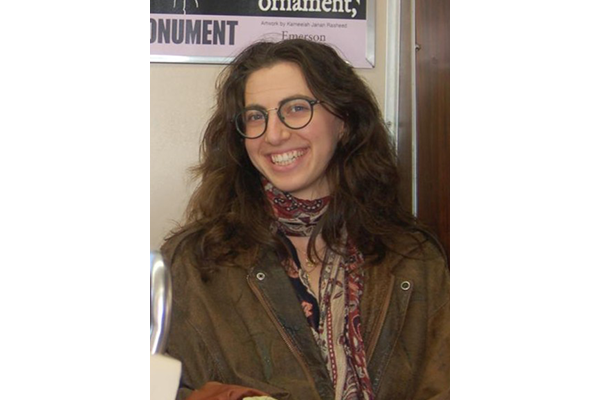
Maya Einhorn portrait. Courtesy photo.
Maya Einhorn, E/MS ’26, combined bioengineering and biochemistry, is currently an undergraduate research assistant at the Dai Lab at Northeastern. With two co-ops and ongoing research experience under her belt, Einhorn is eager to further explore opportunities in the stem cell field.
Maya Einhorn pursued both a bachelor’s and master’s degree in combined bioengineering and biochemistry at Northeastern University. Inspired by her father’s work as an engineer, she grew up with a love of biology and an early assumption that she would become a doctor. College was always the next step, and her parents encouraged her throughout the process. Born in Boston, Einhorn was naturally drawn to Northeastern—particularly its Co-op Program and global opportunities. Where other schools had begun to blur together in her research, Northeastern stood out. She applied drawn by the promise of a distinctive college experience designed to set students up for successful careers, and she was not disappointed.
Einhorn arrived as a biology and math major but quickly sensed something was missing. After reading about the bioengineering program, she found herself drawn to engineering and made the switch—describing bioengineering as “scratching all the different parts of [her] brain.” Already on the pre-med track, she also pursued a major in biochemistry, a decision she is glad she stuck with for the hands-on lab experience it provided.
Co-op Experiences
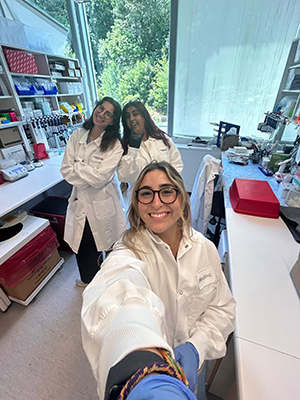
Einhorn and her lab mates at Morphic. Courtesy photo.
Einhorn has completed two co-ops during her time at Northeastern. Her first was at Morphic Therapeutic, where she worked as a screening biology co-op. Morphic’s work centers on developing treatments for Crohn’s disease and inflammatory bowel disease (IBD) by targeting three proteins responsible for driving these conditions. The company had already developed drugs targeting two of those proteins; Einhorn’s project focused on the third, with the longer-term goal of combining all three drugs into a single treatment that would shut down all harmful protein activity at once. Her work involved testing chemical compounds for their ability to bind to the third protein and block its function, as well as measuring how effectively each compound bonded. After presenting her findings to the team, the chemists would return to their work and bring Einhorn new compounds to test.
The experience sharpened her data analysis and presentation skills, and she valued the opportunity to share her work with a team of researchers. Einhorn found it “very intellectually engaging due to all of the out-of-the-box thinking we had to do,” and credits the co-op with building the foundational wet lab skills she will need for her future ambitions.
Her second co-op was at Prolific Machines, a startup working in optogenetics—the use of light to control genetically engineered biological processes. The company’s primary focus is scaling up the production of specific proteins by incorporating light-sensitive switches into a protein’s genetic controls; when light is applied to those switches, it triggers production of the desired protein, allowing for precise and reliable control over the process. As a synthetic biology co-op, Einhorn’s tasks included copying and inserting genetic material into cells and collecting and analyzing the proteins those cells produced. She thrived in the fast-paced environment and came away with a broad range of technical and communication skills she applied every day on the job.
Research
Einhorn is currently an undergraduate research assistant at the Guohao Dai Lab at Northeastern, where the team studies cardiac stem cells. Stem cells are notable for their ability to develop into virtually any cell type in the body; the Dai Lab uses cardiac stem cells to grow functional heart tissue that can even begin to beat on its own. Einhorn’s research focuses on using calcium markers to track the electrical signals produced during these beats. When a heart cell fires an electrical signal, calcium flows in and out of the cell as part of the process—acting as a messenger that carries the signal through the tissue. By attaching a glowing green protein to the calcium, the team can visually follow its movement through the tissue with each beat, an effect Einhorn describes as looking like “green Christmas lights” under the microscope. Because the brightness of the glow corresponds to the amount of calcium present at any given moment, it serves as a measure of the strength and intensity of the electrical signals moving through the tissue.
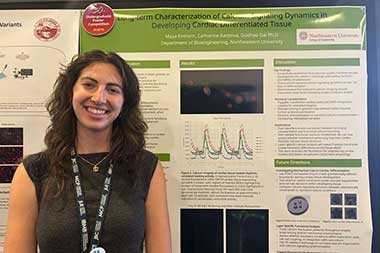
Einhorn presenting her research at the ASBMB conference. Courtesy photo.
The team also studies how cell shape influences this process. As cells grow, researchers use tiny cutout molds—stars, ovals, and other forms—to guide how each cell develops, then examine how sharp corners versus rounded edges affect the way a cell organizes itself and generates electrical activity. Einhorn received the PEAK Summit Award for Fall 2025 for this research, and the project has sparked what she describes as a deep and growing interest in stem cell research.
Outside the lab and classroom, Einhorn is a member of the Model UN club, the International Relations Council (IRC). The organization challenges students to engage with global issues from a geopolitical perspective through conferences and structured discussions representing the viewpoints of different countries. Einhorn has participated in Model UN since middle school and credits it with broadening her worldview well beyond her own experiences. The conferences have built her interpersonal skills—particularly communication and conflict resolution—and sharpened her ability to think on her feet, especially during “crisis” segments, in which participants must drop their current topic and immediately respond to a new, unexpected problem. She sees these skills as directly applicable to her professional life.
Einhorn also co-hosts an art and science podcast with a friend, in which they interview professors about their research and invite them to frame it through a creative and artistic lens. And she has found volunteering deeply rewarding—most recently through the Science Club for Girls at Northeastern, which pairs college students with Boston-area classrooms to introduce young girls to science.
Appreciation, Advice, and Ambition
One course that made a lasting impression on Einhorn was a Biology Inquiries class—a discussion-based seminar built around readings on the most novel developments in the field. It sparked her interest in future-facing research and gave her a window into where the science is headed. It also introduced her to a valued mentor: Professor of Biology, Tim Duerr. Since the course, Professor Duerr has supported Einhorn’s academic journey in numerous ways, from writing recommendation letters to helping her navigate the often complex processes of academia. She is grateful for his steady encouragement and guidance throughout her time at Northeastern.
Her advice to other students is to “dive into something headfirst, even if you have no background in the subject.” In her experience, students who try something new quickly discover that they already have the tools to succeed—they just haven’t had the chance to use them yet. Einhorn is a strong believer in experiential learning, pointing to hands-on opportunities as the settings where she has grown the most. Being able to figure things out on her own, she says, has been the most powerful way to build genuine confidence in her abilities.
Einhorn is grateful for the breadth of experience she has accumulated at Northeastern. Time in both academic and industry labs has given her not only a diverse skill set but a wide professional network—a strong foundation from which to launch her career. Her overarching goal is straightforward: do work she loves while making the greatest possible impact. Since graduating, she plans to pursue a PhD in stem cell research before eventually returning to industry, motivated by the belief that expanding human knowledge only fully matters when that knowledge is translated into products that help people. With her strong foundation and commitment to that goal, Einhorn is well positioned to make her mark in whatever corner of bioengineering she chooses to pursue.