Unlocking the Secrets of Cellular Memory
BioE Professor Ning Wang explores how cells retain and respond to past physical forces, advancing our understanding of cellular memory and opening up new possibilities for treating aging and various diseases.
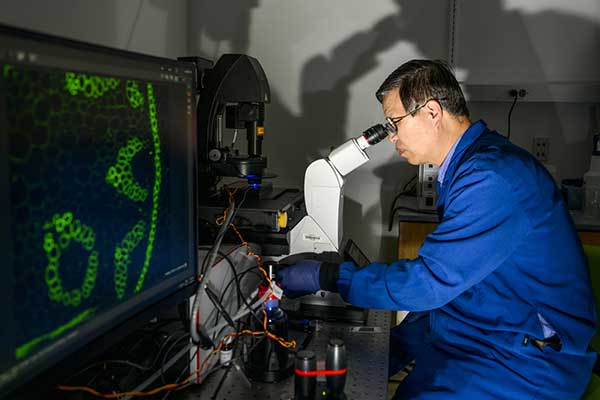
This article originally appeared on Northeastern Global News. It was published by Rich McKay. Main photo: Ning Wang, a Northeastern professor and Founding Director Institute for Mechanobiology, has recent paper on cell memory. Photo by Matthew Modoono/Northeastern University
The medicine of the future could be driven by mechanical cell memory
Wrinkle loss, better exercise and new cancer treatments could all come from mechanical cell memory.
It’s not a cure for baldness.
But it might eliminate your crow’s feet and laugh lines by telling the tissues in your face how to remember their more elastic youth.
It might develop into ways for older people to exercise for a few minutes and get the results of an hour.
And it could possibly lead to new medicines that would teach your body’s immune system to target drug resistant melanoma cancer cells and kill them.
It’s called cell memory and it’s the focus of research by Ning Wang, a Northeastern University professor of bioengineering and director of the Institute for Mechanobiology.
“My goal is simple: help keep people healthy,” he said.
A host of cells, along with the neurons in the brain, already have recall. “Memory T cells” or “T lymphocytes” in the blood, for example, are front and center in remembering past infections in the body and are part of the body’s adaptive immune system attacking foreign cells.
But Wang and his co-authors have found that many other cells have this so-called “mechanical memory,” which is the ability to remember that recent physical force was applied and continue to react as if the force is still there.
When force such as exercise or other energy stimulation is applied to cells, the inner workings of the cell kick into gear and they cook up a host of proteins that affect the body, such as telling it to build more muscle. The reaction is not permanent, lasting short while, but what’s important is that the reaction in the cell wasn’t thought to continue at all, Wang said.
Read full story at Northeastern Global News