Engineering in the World of Medicine
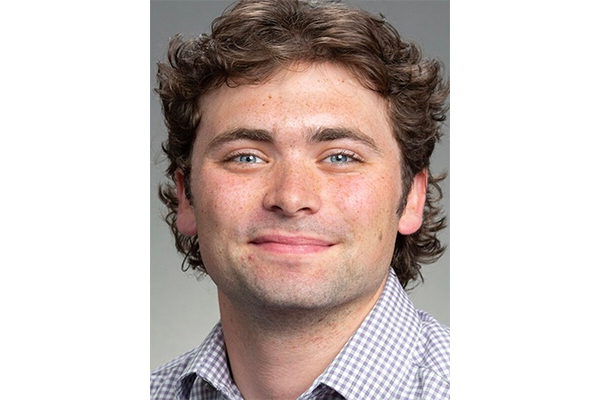
Portrait of James Belanger. Photo sourced from LinkedIn.
James Belanger, E ’25, biochemistry and bioengineering, completed two co-ops—one in a research lab and one in a hospital. With medical school beginning this summer, Belanger hopes to build a career that integrates his passions for both medicine and engineering.
James Belanger graduated last year with a bachelor’s degree in biochemistry and bioengineering from Northeastern University. He has always gravitated toward the sciences—biology, physics, and chemistry in particular—and came to college knowing medical school was a possibility but unsure exactly what he wanted to study. Engineers in his family inspired him, and he entered his first year undecided but curious about the field. That curiosity was answered almost immediately: Cornerstone of Engineering, taken his first semester, drew him in with its collaborative energy and hands-on approach. He declared bioengineering with biochemistry shortly after, positioning himself for the pre-med track he had been considering all along.
Growing up in New England, Belanger wanted to stay in the region for college and looked naturally toward Boston. Like many students, the Co-op Program was a major draw. “It’s exceptional,” he says—hearing about what friends of friends had accomplished through it made a clear impression. Beyond the program itself, the feel of the campus won him over: lively and urban, but with enough of a campus atmosphere to feel like a genuine college experience.
Classroom Highlights

Belanger and his team presenting their Capstone project. Courtesy photo.
Though Cornerstone first ignited his interest, subsequent courses kept the fire going. Biomechanics, taught by Associate Chair for Undergraduate Studies and Teaching Professor Timothy Lannin, was a standout—both for its content and for Professor Lannin’s unmistakable enthusiasm in the classroom. Belanger felt he “radiated positive energy,” and the genuine investment Professor Lannin made in his students’ success left them, in Belanger’s words, “proud to be a bioengineer.” He also credits Adjunct Professor Aurelie Edwards, whose Quantitative Physiology course—an exploration of how the body works through a mathematical and scientific lens—was among the most demanding he took. The difficulty was matched by Professor Edwards’s passion for the material and her commitment to student understanding. “The amount of time she put into it was made very clear,” Belanger says.
He also highlights his Capstone project, in which his team built a device that replicates how glaucoma behaves in the human eye. Rather than culturing cells in isolation, the “glaucoma-on-a-chip” gives researchers a more realistic model of the disease’s progression, with potential applications in drug discovery. Technically, the project taught him how to integrate and compile different resources; personally, it taught him resilience. “It’s important to stay excited about your project—it’s going to work out, even if it takes a little longer than you think,” he says. He considers Capstone a rare and valuable opportunity and encourages younger students not to take the support built into it for granted.
Experiential and Extracurricular Opportunities
Belanger completed his first co-op at Wave Life Sciences, a mid-sized biotechnology company focused on developing gene therapies for rare genetic diseases. On the process development team, he worked to refine the processes used to manufacture their drugs and spent some time gathering patient feedback on their products—an aspect of the role he found especially rewarding, as it connected his lab work directly to the people it was meant to help. He also developed his ability to communicate across teams, keeping different groups aligned and informed. Northeastern’s laboratory coursework had prepared him well for the technical side of the role, and he left with a genuine appreciation for the science and the people working in the genetic disease field. But he also left with a clearer self-knowledge: a lab environment, he realized, wasn’t where he wanted to build his career. He wanted more direct contact with patients.

Belanger working at Tufts Medical Center, his second co-op. Courtesy photo.
That realization led to his second co-op at Tufts Medical Center, where he worked as a clinical care technician in the surgical critical care unit—a high-intensity environment where many patients depend on advanced life-support equipment. His responsibilities spanned patient transport, life-support machine maintenance, vitals monitoring, hygiene care, and supporting the nursing staff, as well as helping prepare patients for surgery and settle them in afterward. He enjoyed the experience so much that he stayed on part-time until graduation. The intensity of the environment never wore him down; if anything, the camaraderie with his colleagues and the immediate, visible impact on patients’ lives kept him energized. Watching medicine “pushed to its limits” became the defining factor in his decision to pursue medical school.
Outside the classroom and the clinic, Belanger explored intramural sports—basketball, kickball, and more—finding both good exercise and a welcoming social community in the process. “I think there is something for everyone,” he says, “and if there is something you want to try, doing it through Northeastern is definitely the way to do it.” He also served as an emergency medical technician for Beauport Ambulance Service, responding to emergency calls and routine patient transfers. The mix of high-stakes moments and everyday care gave him a well-rounded introduction to patient-facing work, and he recommends the experience to anyone considering a career in medicine.
Recommendations and Future Plans
Belanger’s advice to current students is straightforward: try everything. “You’re not going to know what you’re into unless you give it a go,” he says—a principle he has lived by. He never would have discovered his interest in engineering had he not walked into Cornerstone his first semester. He encourages students to resist the “tunnel vision” that can take hold in a rigorous academic environment and to experiment broadly with both coursework and extracurriculars. Exploring your interests, he believes, “is the best thing you can do for yourself” as a student.
Belanger is currently working as a research assistant in Brown’s Emergency Medicine Department and will begin a full-time medical degree program at the Warren Alpert Medical School of Brown University in August. He is keeping an open mind about which specialty to pursue, unwilling to close doors before he has had the chance to look through them. His longer-term hope is to work at the intersection of medicine and engineering—perhaps as a physician consultant to medical device companies, where both sides of his education could be put to use. At the core of all of it is a motivation he describes simply: use his opportunities to improve the lives of people less fortunate than himself. Whatever path his career takes, that commitment will remain constant.